Artemis I Orion Re-entry
Recent discussions around Artemis II have focused on Orion’s re-entry performance, particularly the reliability of its heat shield. During Artemis I, localized Avcoat material deterioration raised questions about thermal margins and how the re-entry environment should be interpreted. At the center of this is the time-integrated thermal response of the heat shield under extreme conditions.
Hypersonic re-entry is inherently multidisciplinary. Decisions rarely depend on peak values alone, but also on how thermal, aerodynamic, and trajectory effects evolve together over time — making a system-level view essential under tight timelines.
To illustrate this, I ran a case study of the Artemis I Orion capsule re-entry using a physics-based, low-fidelity framework I’ve been discussing here recently.
This is not an accurate reconstruction of Orion’s TPS performance. It demonstrates how low-fidelity physics models can provide fast, traceable insight into complex environments when rapid understanding is needed.
Inputs, Outputs, and Assumptions
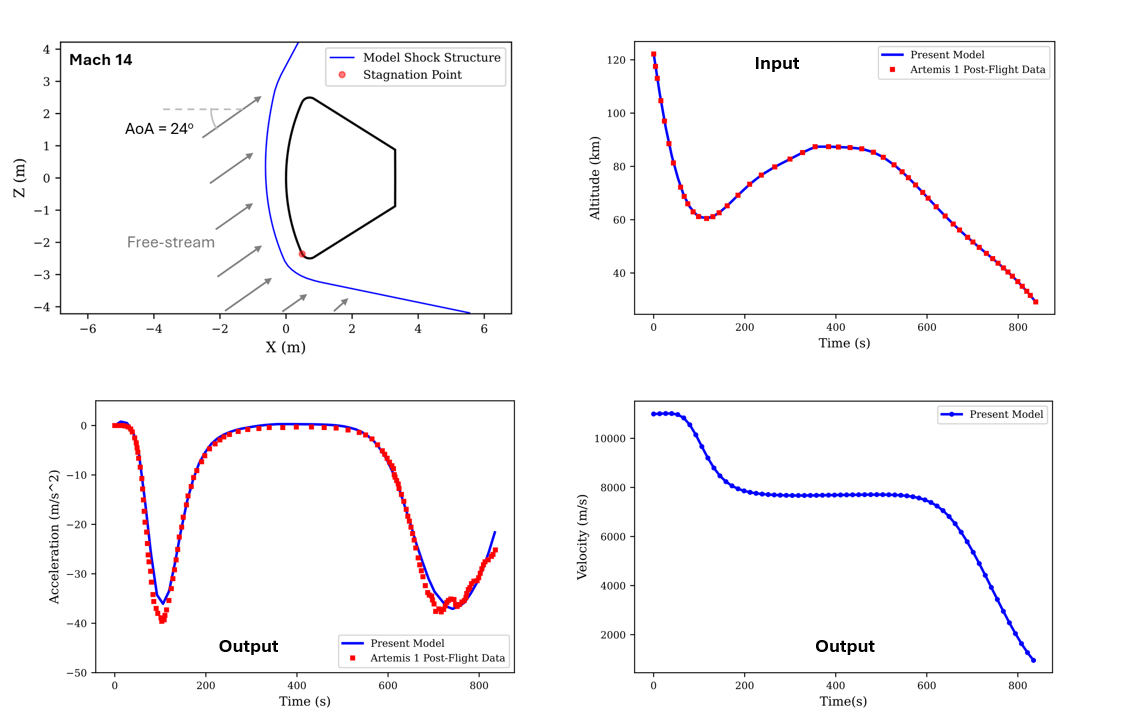
Inputs: Geometry and mass properties, 1976 US Standard Atmosphere, Avcoat thermophysical properties, re-entry altitude profile, aerodynamic coefficients, and entry-point velocity. (from Orion Artemis I Entry Performance by Rea, McNamara, Kane).
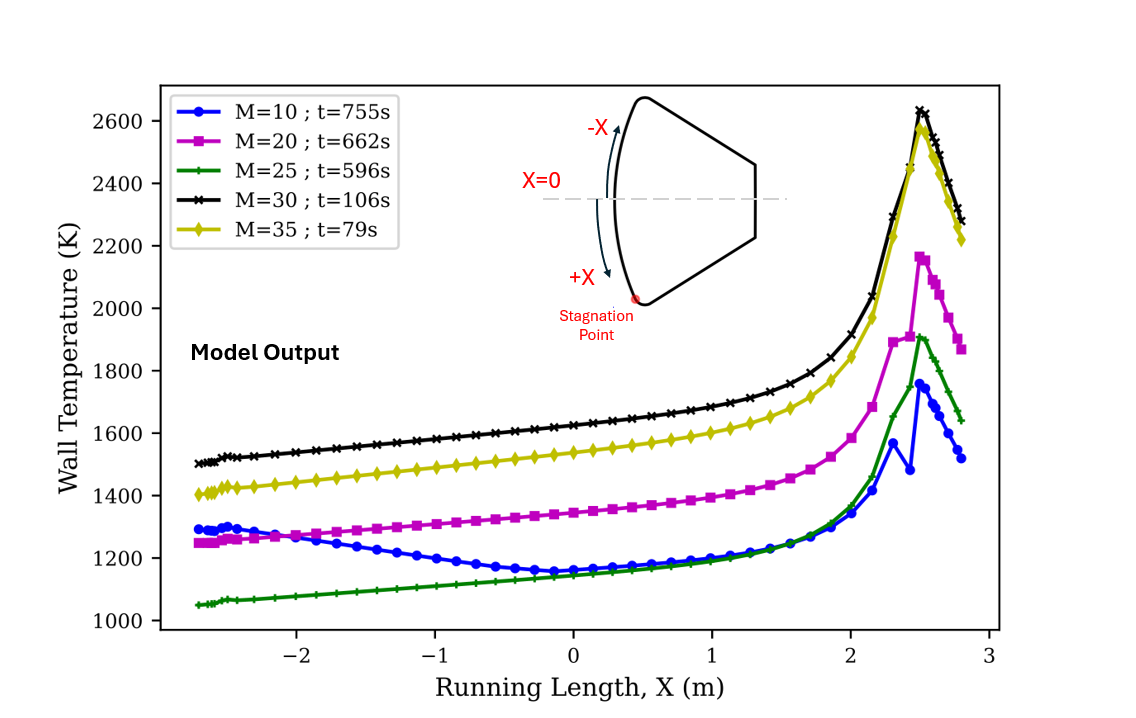
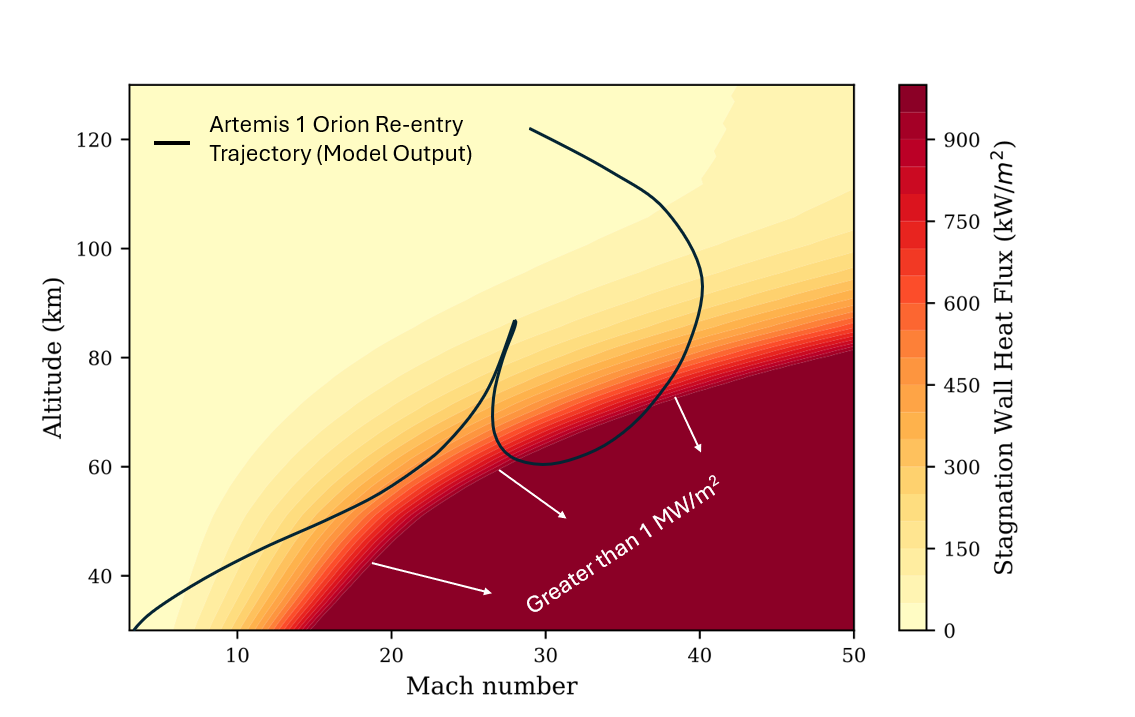
Outputs: 2D centreline shock structure, acceleration and velocity histories, altitude–Mach evolution, and windward centreline surface heat-flux and temperature profiles.
Key assumptions: Constant AoA = 24°, 3-DoF trajectory model, approximate shock representation, negligible entropy-layer effects, 1D conjugate heat transfer, Avcoat interior temperature fixed at 300 K, Eckert RTM for convection.
Not considered: Real-gas effects, material integrity, deterioration, or ablation physics.
Why are these results relevant?
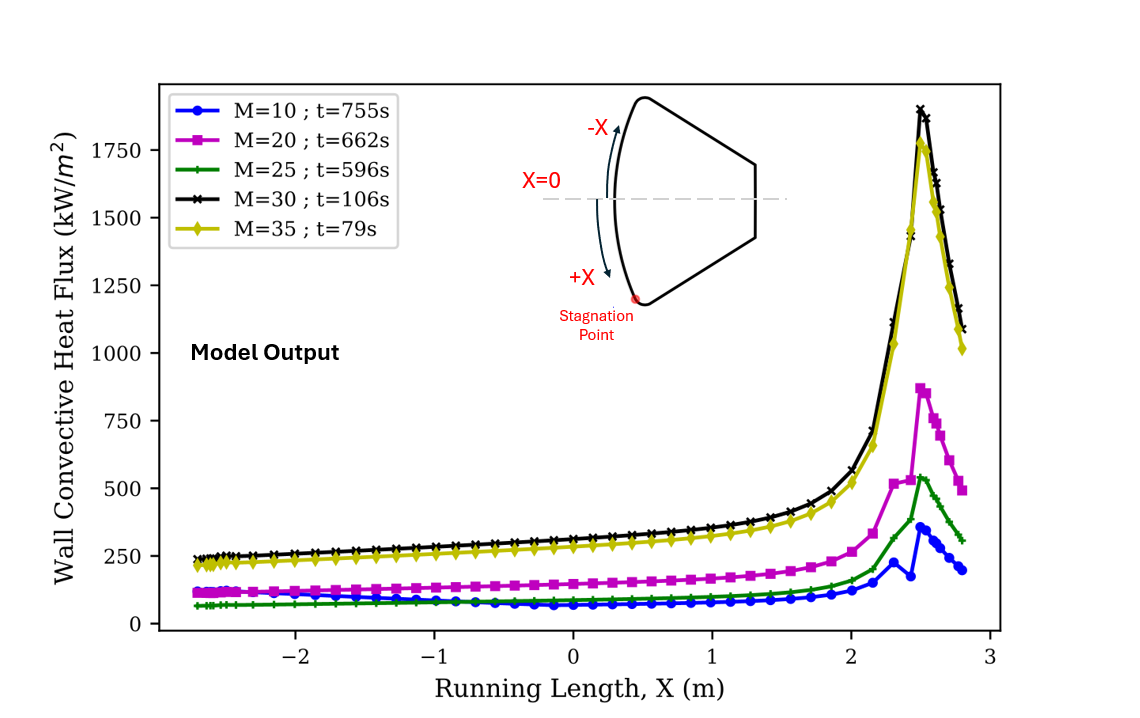
The plots shown below are not valuable because of their absolute numbers. Their value lies in what they enable: a time-resolved, physics-grounded view of material thermal loading, which is often the critical input during design trade studies, anomaly interpretation, and operational decision-making.
Physics-based low-fidelity tools are not a substitute for high-fidelity CFD, testing, or certification analysis. Their strength is different: they provide speed, transparency, and traceability, allowing engineering judgment to be exercised explicitly rather than implicitly. When applied correctly, they help reduce redesign loops, compress timelines, and lower program risk — particularly for high-consequence aerospace systems.